

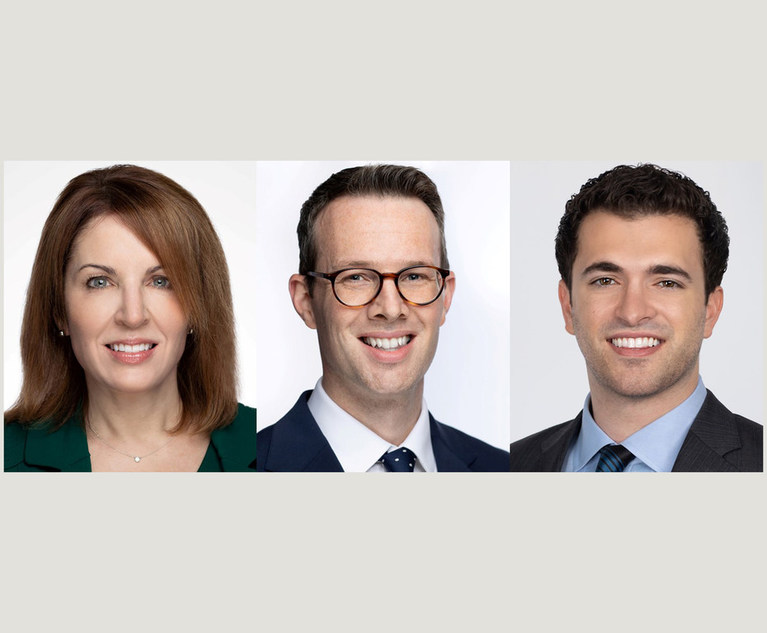
 (L-R)Courtney Horrigan, Dominic Rupprecht and Zachary Roman of Reed Smith. Courtesy photos
The costs of responding to a government subpoena or investigative demand can be substantial. The broadly worded demands for information or testimony typically require burdensome searches through mountains of documents, data, and electronically stored information. With the looming threat of civil or administrative actions against the company and its executives—and possible referral to the Department of Justice for criminal proceedings—a misstep in responding to a subpoena or investigative demand can be devastating.
As subpoena-response costs rise into the millions of dollars, the question inevitably rises: Will the company's director's and officer's (D&O) or professional liability insurance cover the costs of responding to the subpoena or civil investigative demand? The answer to this question is not always clear. Given the high stakes, insurers and policyholders frequently litigate this issue, with courts across the country reaching different outcomes depending on the unique terms, definitions, and conditions of the policies at issue. Two recent decisions addressing insurance coverage for the costs of responding to government subpoenas—one finding coverage and the other rejecting it—provide helpful guidance for policyholders seeking coverage for these costs.
In Conduent State Healthcare v. AIG Specialty Insurance, C.A. No. N18C-12-074 (Del. Super. Ct. June 24, 2019), the Delaware Superior Court considered whether a civil investigative demand issued by the Texas Attorney General "investigating the possibility of Medicaid fraud involving the prior authorization process for orthodontia services" qualified as a "Claim" for a "Wrongful Act" as required to trigger coverage under the policyholder's professional liability policy. As is typical in these disputes, the insurer denied coverage arguing: the civil investigative demand did not qualify as a "claim," which the policy defined to include "a written demand for money, services, non-monetary relief or injunctive relief," and the civil investigative demand did not allege that the policyholder committed a "wrongful act."
After surveying the "split of authority" on these issues, the Delaware court rejected both of the insurer's arguments, and held that the civil investigative demand triggered defense costs coverage under the professional liability policy. The court held that a civil investigative demand fits within the insurance policy's definition of a "claim" "because it is a 'demand for … nonmonetary relief' specifically targeted at the insured." While recognizing that some courts rejected this conclusion, the Delaware court noted that those decisions failed to account for the fact that a civil investigative demand (like an SEC subpoena) empowered the issuing government agency to compel compliance without the need for judicial intervention.
With respect to the issue of whether the civil investigative demand alleged a "wrongful act," the court rejected the insurer's hyper-technical approach, and concluded that "investigating an alleged unlawful act by the insured" and "actually alleging an unlawful act" is, for purposes of the insurance policy, "a distinction without a difference." Here, the court followed the decision in Oceans Healthcare v. Illinois Union Insurance, 379 F. Supp. 3d 554 (E.D. Tex. 2019), which similarly held that an Office of Inspector General Subpoena was a "claim for a wrongful act," because a subpoena issued in connection with an investigation of alleged unlawful activity, contains all information "tantamount to alleging a wrongful act."
While Conduent provided a victory for policyholders, the recent decision in Hertz Global Holdings v. National Union Fire Insurance, No. 19-cv-6957 (S.D.N.Y. March 30, 2021), demonstrates the high stakes of these coverage fights, and the serious challenges policyholders still face in securing coverage for the costs of defending against an agency subpoena.
In Hertz the policyholder allegedly incurred $27 million in fees and costs responding to an SEC subpoena issued in connection with a Formal Order of Investigation. Like the insurer in Conduent, the insurers in Hertz argued that the subpoena did not constitute a "securities claim" and did not allege a "wrongful act" by an insured. The court sided with the insurer on both questions.
The decision in Hertz turned on the unique terms of the D&O policy itself. The policy defined "securities claim" as "a claim, other than an investigation of an organization" alleging violation of securities laws or regulations. The court held that this language "unambiguously excludes an SEC investigation against Hertz from coverage." While the policyholder relied on the recent decision in Patriarch Partners v. AXIS Insurance, No. 16-CV-2277 (S.D.N.Y. Sept. 22, 2017), aff'd, 758 F. App'x 14 (2d Cir. 2018), which confirmed coverage for the costs of responding to an SEC subpoena, the court found that Patriarch Partners was distinguishable because it presented different policy language. The court concluded that the policy in Patriarch Partners expressly included coverage for the cost of responding to government investigations, while the Hertz policy expressly excluded coverage for those costs.
The Hertz court also departed from the precedents in Conduent and Oceans Healthcare on the issue of whether the subpoena alleged a wrongful act, concluding instead that the formal investigative order "did not accuse Hertz of violating federal securities laws, but instead used language to indicate that it had information suggesting that Hertz might have violated the securities laws, which is why it wanted to investigate." The decision in Hertz is the subject of a motion for reconsideration, which is fully briefed and remains pending as of June 10.
The decisions addressed above underscore the fact that coverage can be won or lost at the point the policy is placed. Policyholders must pay attention to terms that limit coverage for investigations and recognize that coverage exclusions appear throughout their policies, and not just in the "exclusion" section—for example, the limitation on "investigation" coverage seized on by the insurer in Hertz was included in the policy's "definition" section. Coverage counsel and brokers can help identify terms that may be used to limit entity investigation coverage and assist policyholders with negotiating policy language revisions and with exploring alternative carriers or captive insurers that would expressly provide coverage for these types of risks.
The high costs of government investigations and the length of time over which investigations may persist increase the likelihood of coverage disputes following receipt of a subpoena or civil investigative demand. If an insurer denies coverage, the policyholder should not take "no" for an answer. Decisions denying coverage are often based on the quirks of the particular policy at issue. For every case finding that the costs of responding to a subpoena or civil investigative demand are not covered, there are many more decisions confirming coverage in these exact circumstances.
Reed Smith partner Courtney Horrigan is a member of the insurance recovery group and represents public and private corporations and non-profits in insurance coverage litigation and domestic and foreign arbitrations. She also counsel policyholders during renewals and placements of management liability insurance. She can be reached at [email protected].
Partner Dominic Rupprecht is a member of the firm's insurance recovery group and litigates insurance coverage disputes on behalf of policyholders for a wide range of claims, including environmental, cyber, mass torts, first-party losses and False Claims Act liabilities. He can be reached at [email protected].
Zachary Roman, an associate with the firm, is a member of the insurance recovery group and focuses his practice on insurance recovery, financial services and commercial litigation matters. He can be reached at [email protected].